Right of Way: DGT theory test questions in English
Chapter 5 of 17 · 24 questions
Who goes first at intersections, roundabouts, narrow stretches and steep slopes, including the priority-to-the-right rule that has no US equivalent. This is one of the chapters that fails the most US drivers.
Practice it properlyAnswer these one at a time and track the chapters you keep missing, or sit a timed 30-question mock exam.
1.You're driving a car. You and an animal-drawn vehicle enter a narrow stretch of road with no priority signs at the same moment. Who has the right of way?
You, in the car.
Whichever vehicle would have to back up the farthest.
The animal-drawn vehicle.
Show answer
Answer: C. The animal-drawn vehicle.
On a narrow stretch with no priority signs, the vehicle that entered first goes first. If both enter at the same time, or it's unclear who was first, the vehicle that has more trouble maneuvering has priority. An animal-drawn vehicle is much harder to back up than a car, so it goes first. The backing-up distance only settles ties between vehicles of the same type.
2.Does a marked crosswalk give pedestrians the right of way?
Yes, always.
Only when the crosswalk has a traffic light.
Never.
Show answer
Answer: A. Yes, always.
A marked crosswalk is shown by wide white stripes painted parallel to the direction of the road. Vehicles must always yield to pedestrians there. A traffic light is not needed for this priority, so the other options are wrong.
3.At an intersection with traffic signs, a police officer is temporarily directing traffic. What should you do?
Apply the general rule of yielding to vehicles coming from your right.
Obey the traffic signs that set the right of way.
Obey the officer's signals.
Show answer
Answer: C. Obey the officer's signals.
When signals conflict, follow this order: traffic officers first, then temporary signs such as barriers, then traffic lights, then vertical signs, and finally road markings. The officer's signals override both the signs and the general right-of-way rules.
4.You are turning onto another road and pedestrians are crossing it. Should you yield to them?
Yes, but only if there is a crosswalk.
No.
Yes.
Show answer
Answer: C. Yes.
Vehicles generally have priority over pedestrians, but Article 65 makes an exception: when you turn onto another road, you must yield to pedestrians crossing it. This applies even if there is no marked crosswalk, so the other options are wrong.
5.You are driving a car and meet a truck on a very narrow section of road with no priority signs. Who should go first?
The truck, if it is not clear which vehicle entered first.
You, because your car is smaller.
You, because your car has less trouble getting through.
Show answer
Answer: A. The truck, if it is not clear which vehicle entered first.
On a narrow section without signs, the vehicle that entered first has priority. If that is unclear, priority goes to the vehicle that has more difficulty backing up. Here that is the heavier, larger truck. Being smaller or getting through more easily does not give a car priority.
6.You're driving on a freeway (autopista) and another vehicle is merging onto the road from an on-ramp. Do you have to do anything?
No.
Yes, make it as easy as possible for the other vehicle to merge.
Yes, stop to let the other vehicle in.
Show answer
Answer: B. Yes, make it as easy as possible for the other vehicle to merge.
Drivers already on a freeway or divided highway (autovía) must help merging vehicles get on the road as much as they reasonably can. Under no circumstances should you slow down to yield to them, and you certainly shouldn't stop. Doing nothing is also wrong, because you're expected to cooperate so the merge goes smoothly.
7.A bus is pulling out of a marked bus stop. Must you yield to it?
Yes.
No.
Only if it's a school bus.
Show answer
Answer: A. Yes.
Spanish rules require drivers to make it as easy as possible for vehicles to rejoin traffic, especially public transport buses leaving a marked stop. In built-up areas, you should move over if you can or slow down to let the bus pull out. This applies to any public passenger bus, not only school buses.
8.A tractor is coming out of a farm onto your road, from your right. There are no signs. Must you yield?
No, because it's coming from a private road.
Yes, because it's coming from your right.
Yes, because there are no signs.
Show answer
Answer: A. No, because it's coming from a private road.
The general rule at intersections is to yield to vehicles coming from your right. One exception is a vehicle coming from a private or unpaved road, which must yield to traffic on the paved road. A farm exit counts as a private road, so the tractor must yield to you.
9.You are pulling out of an unpaved road onto a paved one. Which vehicles must you yield to?
All vehicles traveling on the paved road.
Only vehicles coming from your right.
Only vehicles coming from your left.
Show answer
Answer: A. All vehicles traveling on the paved road.
Vehicles leaving an unpaved road must always yield to traffic on the paved road. This is an exception to the usual yield-to-the-right rule, so it doesn't matter which side the other vehicles come from.
10.A car is pulling out of a gas station to join traffic. When must it yield, if needed?
When it merges to the left.
When it merges to the right.
Whether it merges to the right or left.
Show answer
Answer: C. Whether it merges to the right or left.
A vehicle joining the road from a stop, a parking spot or a gas station must first make sure it can do so safely. It must yield to all vehicles and road users already on the road, considering their position, path and speed. The direction it turns makes no difference.
11.On a narrow road with no signs, two cars can't pass each other. Which one has the right of way?
The one that finds the maneuver harder.
The one that would have to back up farther.
The one that entered the narrow stretch first.
Show answer
Answer: C. The one that entered the narrow stretch first.
When no sign sets the right of way on a narrow stretch, the vehicle that entered first goes first. Only if it's unclear who entered first does the vehicle that would find backing up harder get priority.
12.When an emergency vehicle on an emergency call is approaching, you...
must stop your vehicle.
must yield, and even stop if necessary.
must always move over to the right.
Show answer
Answer: B. must yield, and even stop if necessary.
Police, fire, civil protection, rescue and medical vehicles on an emergency call have priority over all other road users. You must yield to let them pass, usually by moving to the right, and stop if necessary. Stopping isn't always required, and moving right isn't always possible or correct.
13.On a stretch of road where buildings open directly onto the road, do you need to take extra care?
Yes, you should honk to warn others you're coming.
Yes, you should slow down.
No.
Show answer
Answer: B. Yes, you should slow down.
Where buildings have direct access to the road, you must take extreme care and reduce your speed as much as needed. This helps you avoid hitting a vehicle pulling out from a driveway or parking area. Honking is not the required precaution.
14.When you join the flow of traffic, you must...
yield to other vehicles.
not join without your parking lights on.
join as quickly as you can.
Show answer
Answer: A. yield to other vehicles.
When you use an acceleration lane to merge, you must check at its start that you can join safely, and yield to vehicles already on the road if needed. Parking lights have nothing to do with it, and rushing in without yielding is dangerous.
15.You reach an intersection with no right-of-way signs. Which vehicles must you yield to?
All vehicles coming toward you.
Vehicles coming from your right.
You don't have to yield to anyone.
Show answer
Answer: B. Vehicles coming from your right.
At an intersection with no signs or signals setting priority, you must yield to vehicles approaching from your right. There are exceptions, such as roundabouts, where vehicles already inside always have priority over those entering.
16.On a narrow stretch of road with no right-of-way signs, which vehicle goes first?
The first vehicle to enter the narrow stretch.
The first vehicle to reach the narrow stretch.
The vehicle that would have to back up farther.
Show answer
Answer: A. The first vehicle to enter the narrow stretch.
When no sign sets priority on a narrow stretch, the vehicle that entered it first has the right of way. Simply arriving first isn't enough. Only if it's unclear who entered first does the vehicle that would find backing up harder get priority.
17.You see a bus that wants to pull out from its stop into traffic. What should you do?
Take care, even though you have absolute right of way.
Make it easier for the bus, stopping if necessary.
Keep driving normally, since the bus has no right of way.
Show answer
Answer: B. Make it easier for the bus, stopping if necessary.
Spanish law requires drivers to make it as easy as possible for vehicles to rejoin traffic, especially public transport buses leaving a marked stop. In built-up areas, move over if you can or slow down, and stop if needed. You don't have absolute priority here, and ignoring the bus is wrong.
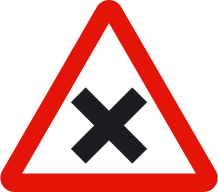
18.Do you have to yield at the next intersection?
No, you don't have to yield to anyone.
Yes, to vehicles coming from your left.
Yes, to vehicles coming from your right.
Show answer
Answer: C. Yes, to vehicles coming from your right.
This sign (P-2) warns of an intersection where the general priority-to-the-right rule applies. You must yield to every vehicle that reaches the intersection from your right. Vehicles on your left have to yield to you, and you are never free of all yielding here.
19.Drivers of priority emergency vehicles on an emergency call...
must obey traffic lights.
must try not to interfere with right of way at intersections.
are exempt from all traffic rules.
Show answer
Answer: B. must try not to interfere with right of way at intersections.
Emergency drivers on an emergency call must try not to violate or interfere with right of way at intersections or traffic lights. They may only do so after first taking extreme precautions. They must make sure there's no risk of hitting pedestrians and that other drivers have stopped or are about to make way. They aren't exempt from every rule, and they aren't strictly bound by traffic lights either.
20.You want to move into another lane going the same direction. Who has the right of way?
Cars, in every case.
The vehicle already traveling in the lane you want to enter.
You, because you are the one changing lanes.
Show answer
Answer: B. The vehicle already traveling in the lane you want to enter.
Any lane change must respect the priority of vehicles already in the lane you want to move into, so they have the right of way. You must also signal in advance. Being a car gives no special priority, and changing lanes never gives you the right of way.
21.You reach an intersection with no signs or signals controlling the right of way. Do you have to yield?
No.
Yes, to vehicles approaching from your left.
Yes, to vehicles approaching from your right.
Show answer
Answer: C. Yes, to vehicles approaching from your right.
When nothing regulates the right of way, the general rule in Spain is to yield to vehicles coming from your right. There are exceptions: paved roads have priority over unpaved ones, rail vehicles have priority, and vehicles already in a roundabout have priority over those entering. Yielding to the left is not the general rule.
22.A group of schoolchildren is about to cross the road. Do you have to yield to them?
Yes.
No.
Only if they are using a crosswalk.
Show answer
Answer: A. Yes.
Unlike other pedestrians, a school group has the right of way to cross even where there is no crosswalk. So you must yield to them wherever they cross.
23.You reach an intersection with a yield sign or yield marking on the road. Which vehicles must you yield to?
All vehicles approaching from the right or the left.
Only vehicles approaching from the left.
Only vehicles approaching from the right.
Show answer
Answer: A. All vehicles approaching from the right or the left.
At a yield sign or yield road marking, you must yield to all vehicles on the crossing road, whether they come from the right or the left. You may continue only when no one is traveling across your path. Yielding to one side only is not enough.
24.You have the right of way at an intersection, but traffic ahead means you might get stuck inside it. What should you do?
Go through, since you have the right of way.
Go through, and move out of the way if you block traffic.
Don't enter the intersection.
Show answer
Answer: C. Don't enter the intersection.
Even with the right of way, you must not enter an intersection if you can expect to be stopped inside it and block cross traffic. Wait until the vehicles ahead move on and the way is clear. Having priority doesn't allow you to block the intersection.