Transport of People & Goods: DGT theory test questions in English
Chapter 6 of 17 · 29 questions
Child seats, seat belts, how many people a vehicle may carry, and how loads must be secured and marked. Expect questions on height limits for child restraints and on overhanging loads.
Practice it properlyAnswer these one at a time and track the chapters you keep missing, or sit a timed 30-question mock exam.
1.If a load sticks out past the back of a passenger car, do you have to mark it?
Yes, with a panel placed at the end of the load.
Yes, but only at night or in bad weather.
No, it is not required for passenger cars.
Show answer
Answer: A. Yes, with a panel placed at the end of the load.
Any load that overhangs the back must be marked with a 50 x 50 cm panel with red and white diagonal stripes at the end of the load. The panel is required in daylight and good visibility too, so it is not a night-only rule. At night you also add a red light. Passenger cars are not exempt.
2.Materials that give off dust or could fall off must be carried...
In fully enclosed vehicles only.
In small containers.
Completely and securely covered.
Show answer
Answer: C. Completely and securely covered.
Loads that can give off dust or fall off while you drive must be completely and securely covered, for example with a fitted tarp, so nothing escapes onto the road. The rule does not require a closed vehicle or small containers, just an effective cover.
3.Where should a child under 135 cm tall normally ride?
In a rear seat, in an approved child restraint that fits the child's height and weight.
In a front or rear seat, always with the adult seatbelt.
In any rear seat, using only the adult seatbelt.
Show answer
Answer: A. In a rear seat, in an approved child restraint that fits the child's height and weight.
Children 135 cm or shorter must use an approved child restraint suited to their height and weight, and as a rule they ride in the back. They may ride in front only if the car has no rear seats, all rear seats are taken by other such children, or the restraint cannot be installed in back. An adult seatbelt alone is never enough.
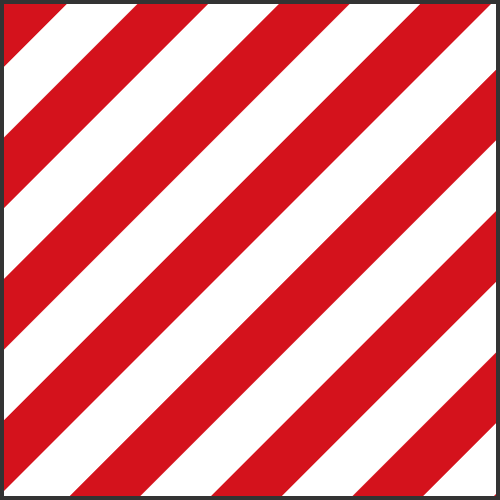
4.Where does this panel go?
On the back of vehicles used only for hauling freight.
On the rear end of a load that sticks out past any vehicle, by up to 10% of the vehicle's length.
On the front and back of vehicles used only for hauling freight.
Show answer
Answer: B. On the rear end of a load that sticks out past any vehicle, by up to 10% of the vehicle's length.
This panel (V-20) marks a load that sticks out past the back of a vehicle by up to 10% of its total length. In daytime, in good weather and with normal visibility, you signal that load with a 50 x 50 cm panel with diagonal red and white stripes, placed at the rear end of the load. It applies to any vehicle carrying a protruding load, not just freight vehicles, and it is not mounted on the front.
5.At night, a load that sticks out past the back of a vehicle must be marked with a reflective panel and...
A red light.
Two yellow lights.
A yellow or white light.
Show answer
Answer: A. A red light.
A rear-overhanging load always needs a red and white diagonal-striped panel at its end. At night you must also add a red light, since red is the color for the rear of a vehicle. Yellow or white lights are not the correct marking.
6.Can a load on a roof rack stick out past the sides of a car?
No, loads on cars may not stick out past the sides.
Yes, up to 0.25 meters on each side.
Yes, up to 0.50 meters on each side.
Show answer
Answer: A. No, loads on cars may not stick out past the sides.
In a passenger car, a load may not stick out past the sides or the front. It may only stick out at the back: up to 15% of the vehicle's length for an indivisible load, or 10% for a divisible one. No side overhang is allowed, whatever the distance.
7.On a truck 5 meters long or shorter, how far may an indivisible load stick out?
Up to one third of the vehicle's length, at both the front and the back.
Up to 2 meters at the front and 3 meters at the back.
Up to 3 meters at the front and 2 meters at the back.
Show answer
Answer: A. Up to one third of the vehicle's length, at both the front and the back.
On goods vehicles 5 meters long or shorter, an indivisible load may stick out up to one third of the vehicle's length at each end, front and back. The fixed 2 m and 3 m figures are not the limits for these vehicles. The load must also be properly secured.
8.In a passenger car, may your load stick out past the sides?
No.
Yes, if you mark it with a red-and-white striped panel.
Yes, as long as the car stays stable.
Show answer
Answer: A. No.
In a passenger car, the load may never stick out past the sides or the front. It may only stick out at the rear: up to 15% of the car's length for an indivisible load, and up to 10% for a divisible one. A striped panel or good stability does not make side overhang legal.
9.A child is under 12 and 125 cm tall. May the child ride in the front seat of a passenger car without an approved child restraint?
No.
Yes, as long as the child wears the seat belt.
No, because a child can't wear a seat belt.
Show answer
Answer: A. No.
Children must use an approved child restraint until they are over 135 cm tall, so a 125 cm child needs one. They must also ride in the back, except when the car has no rear seats or all rear seats are already taken by child restraints. In those cases, the child may ride in front, but still in an approved restraint. A seat belt alone is not enough, and the reason is not that children can't wear belts.
10.You ride a motorcycle with a passenger. What should you keep in mind?
Your braking distance will be shorter.
When you brake, the rear wheel will be harder to slow down.
Your reaction time will be longer.
Show answer
Answer: B. When you brake, the rear wheel will be harder to slow down.
The extra weight of a passenger makes the wheels, especially the rear one, respond later and with more difficulty when you brake. Braking distance gets longer, not shorter, and passing takes more distance. A passenger changes how the bike handles, not your reaction time.
11.On a motorcycle, how far may your load stick out lengthwise?
Not at all; motorcycles may not carry overhanging loads.
Up to 0.25 meters at both the front and the back.
Nothing at the front and up to 0.25 meters at the back.
Show answer
Answer: C. Nothing at the front and up to 0.25 meters at the back.
On vehicles less than 1 meter wide, such as motorcycles and mopeds, the load may stick out up to 0.25 meters at the rear and nothing at the front. Some overhang is allowed, but never at the front.
12.When your vehicle is loaded, its braking distance is...
shorter than when it's empty.
the same as when it's empty.
longer than when it's empty.
Show answer
Answer: C. longer than when it's empty.
The heavier your load, the more force your vehicle needs to stop, so braking distance gets longer. It is never the same or shorter. Extra weight also raises fuel consumption.
13.When a vehicle is stopped, which side should people get in and out on?
Always on the driver's side.
As a general rule, on the side closest to the sidewalk or shoulder.
On either side, as long as they're careful.
Show answer
Answer: B. As a general rule, on the side closest to the sidewalk or shoulder.
As a general rule, people must get in and out on the side closest to the sidewalk or shoulder, away from traffic. On one-way urban roads (vías urbanas), they use the left or right side depending on which side the vehicle is stopped. The driver's side or any side is not the general rule.
14.At night, how must you mark a load that sticks out at both the front and the back?
With a white reflector at the front and a red reflector at the back.
With a white light at the front, and a red light plus a red-and-white diagonal striped panel at the back.
With just a red-and-white diagonal striped panel.
Show answer
Answer: B. With a white light at the front, and a red light plus a red-and-white diagonal striped panel at the back.
Between sunset and sunrise, or when visibility is greatly reduced, a front overhang needs a white light and white reflector, and a rear overhang needs a red light and the red-and-white diagonal striped panel. Reflectors alone or the panel alone are not enough.
15.How should you choose a child restraint?
Based on the child's weight.
Pick the biggest one, so it lasts longer.
Based on the child's age.
Show answer
Answer: A. Based on the child's weight.
Child restraints are chosen by the child's weight (and height), not by age, and you shouldn't buy one bigger than the child needs. They are grouped by weight: groups 0 and 0+ up to 13 kg, group 1 from 9 to 18 kg, and groups 2 and 3 from 15 to 36 kg.
16.How must you carry materials that give off dust or could fall off?
In a fully sealed vehicle.
Completely and effectively covered.
In small containers.
Show answer
Answer: B. Completely and effectively covered.
Loads that can give off dust or fall off must be completely and effectively covered, for example with a suitable tarp, so nothing lands on the road or bothers other traffic. A sealed vehicle or small containers are not what the rule requires.
17.How must you mark a load that sticks out at the front of your vehicle?
With a white light, both day and night.
With a white light, at night or when visibility is greatly reduced.
With a white light and a white reflector, at night or when visibility is greatly reduced.
Show answer
Answer: C. With a white light and a white reflector, at night or when visibility is greatly reduced.
At night or in poor visibility, a front overhang needs both a white light and a white reflector. A light alone isn't enough, and no front marking is required in normal daylight. Rear overhangs use red markings instead.
18.On a motorcycle less than 1 meter wide, how far may your load stick out at the front?
0.50 meters.
0.25 meters.
Not at all.
Show answer
Answer: C. Not at all.
On vehicles less than 1 meter wide, such as motorcycles and mopeds, the load may not stick out at the front at all. It may stick out up to 0.50 meters on each side and up to 0.25 meters at the back, which is where the other figures come from.
19.Can cargo carried in a passenger car stick out past the sides of the car?
Yes, if the cargo is wide and can't be split up.
No.
Yes, as long as the total width stays under 2.5 meters.
Show answer
Answer: B. No.
In vehicles not designed to carry goods, such as passenger cars, the load may never stick out beyond the vehicle's outline. That means no side overhang under any circumstances. Neither an indivisible load nor a total width under 2.5 meters makes it legal.
20.If your vehicle is heavily loaded, what should you keep in mind?
Fuel consumption will go down.
Your stopping distance will be shorter.
Acceleration will be slower and braking distances longer.
Show answer
Answer: C. Acceleration will be slower and braking distances longer.
More weight means more mass to move and to stop, so the car accelerates more slowly and needs more distance to brake. Leave a bigger following gap and allow extra time when merging. A heavy load actually increases fuel consumption and lengthens stopping distance, so the other options are wrong.
21.What is the maximum height allowed for a vehicle including its load?
3 meters.
As a general rule, 4 meters.
2.5 meters.
Show answer
Answer: B. As a general rule, 4 meters.
Under Spain's General Traffic Regulations, the general maximum height for a vehicle on public roads, load included, is 4 meters. The 3 and 2.5 meter figures are not the legal limit for height.
22.You are unloading goods from your vehicle. Can you put them on the sidewalk?
No.
No, unless you set up a warning so pedestrians aren't put at risk.
Yes, as long as no pedestrians are walking by.
Show answer
Answer: A. No.
Goods may not be placed on the sidewalk during loading or unloading, because it is a pedestrian area. They also may not be left on the roadway or shoulder. A warning sign or an empty sidewalk doesn't change this rule.
23.Loading a vehicle with more weight than it is authorized to carry...
affects acceleration, braking, and the vehicle's stability.
has no effect at all on road safety.
only affects the tires, so you need to raise their pressure.
Show answer
Answer: A. affects acceleration, braking, and the vehicle's stability.
Going over the maximum weight listed on the vehicle's inspection card (tarjeta ITV) hurts stability, reduces suspension performance, weakens acceleration, and lengthens braking distance. So overloading clearly affects safety, and the problem is not limited to the tires.
24.Can you place goods on the roadway while loading or unloading?
Yes.
No, as a general rule.
Not on the roadway, but you can on the shoulder and in pedestrian areas.
Show answer
Answer: B. No, as a general rule.
As a general rule, you may not drop, place, or leave goods on the roadway or shoulder during loading and unloading, since they can block traffic or create danger. Pedestrian areas are off-limits too, so the third option is wrong.
25.How many children can ride in a 5-seat car, counting the driver's seat?
4 children, if the car has suitable child safety devices.
6 children at most.
5 children at most.
Show answer
Answer: A. 4 children, if the car has suitable child safety devices.
Each seat can hold only one person, child or adult. With the driver in one seat, 4 seats remain for children, who must use an approved child restraint until they are over 1.35 meters tall. Carrying 5 or 6 children would exceed the number of seats available.
26.A load sticks out from the back of a passenger car. Does it need to be marked?
Yes, but only at night or when weather noticeably reduces visibility.
Yes, both during the day and at night.
No, because the car isn't built only for carrying goods.
Show answer
Answer: B. Yes, both during the day and at night.
A load that sticks out at the rear must always be marked, day and night, with a red-and-white diagonally striped panel at the very end of the load. At night or in low visibility, a red light is also required. This applies to all vehicles, not just trucks.
27.If part of your load falls onto the road, do you have to mark it in some way?
Yes, with the V-16 emergency beacon.
No, you only mark the vehicle when it breaks down.
No.
Show answer
Answer: A. Yes, with the V-16 emergency beacon.
A fallen load is an obstacle, so you must warn other drivers and arrange to have it removed as soon as possible. Since January 1, 2026, you do this with your hazard lights and the connected V-16 emergency beacon, placed as high as possible (usually on the roof). Marking isn't limited to breakdowns.
28.On an urban road (vía urbana), you must load and unload...
always on the side closest to the edge of the roadway.
following only the signs about stopping and parking.
following the rules set by the local authorities.
Show answer
Answer: C. following the rules set by the local authorities.
On urban roads, each town or city government sets its own rules for loading and unloading. That is why you must follow the local authorities' instructions. The other options are too narrow or too rigid to be the general rule.
29.You are driving a passenger car during the day with a load sticking out at the back. Do you have to mark it?
Yes, with an official striped warning panel.
No, it's only required for trucks.
Yes, with a red cloth.
Show answer
Answer: A. Yes, with an official striped warning panel.
A load sticking out at the rear must be marked with an official 50 x 50 cm panel with red and white diagonal stripes, placed at the back of the load. This applies to every type of vehicle, not only trucks. A red cloth is not the approved marking.