Generic speed limits by road type and vehicle, urban limits of 20, 30 and 50 km/h, and when you must slow down. The numbers are the part people forget, so drill this chapter until they stick.
Practice it properlyAnswer these one at a time and track the chapters you keep missing, or sit a timed 30-question mock exam.
1.What is the speed limit on a divided highway (autovía) for a car towing a trailer with a maximum authorized mass (MMA) under 750 kg?
70 km/h.
80 km/h.
90 km/h.
Show answer
Answer: C. 90 km/h.
On freeways (autopistas) and divided highways (autovías), a car towing a trailer has a speed limit of 90 km/h. Under current rules this applies whether the trailer's maximum authorized mass is under or over 750 kg. 70 and 80 km/h are too low for these roads.
2.Your speed counts as suitable when...
you stay within the maximum speed limits.
you adjust it to your own condition, your vehicle, and the surroundings.
you drive very slowly.
Show answer
Answer: B. you adjust it to your own condition, your vehicle, and the surroundings.
A suitable speed lets you keep full control of your vehicle if an obstacle or something unexpected appears. Posted limits are only part of it. You also have to factor in the road, your vehicle, and your own condition. Staying under the limit or crawling along doesn't guarantee a suitable speed.
3.Can a navigation system help you keep track of your speed?
Yes, but your main source of speed information should always be the speedometer.
No, only road signs control your speed.
No, navigation systems can't show you your speed.
Show answer
Answer: A. Yes, but your main source of speed information should always be the speedometer.
GPS navigation systems can show your current speed and help you monitor it. Still, the speedometer should always be your primary source. Road signs and road conditions take priority over whatever the GPS says, so saying it can't help at all is wrong.
4.Speed limits on a road are set...
using criteria such as the road's design speed or how congested it is.
at random, because other countries don't have them.
only by whether the road is urban or rural.
Show answer
Answer: A. using criteria such as the road's design speed or how congested it is.
Maximum limits are based on several criteria, such as the road's design speed, its level of congestion, or whether it is newly built. They aren't random, and urban vs. rural is not the only factor.
5.You are driving a passenger car on a conventional road (carretera convencional). What is your maximum speed while passing another vehicle? (Rules since March 2022)
90 km/h.
100 km/h.
110 km/h.
Show answer
Answer: A. 90 km/h.
The limit for passenger cars and motorcycles on conventional roads is 90 km/h. You used to be allowed to go 20 km/h over the limit while passing, but that has been banned since 2022. So 100 or 110 km/h is never allowed, even when passing.
6.The tunnel effect caused by high speed means you...
can only see the sides of the road clearly.
can only see the center of the road clearly.
become more sensitive to glare.
Show answer
Answer: B. can only see the center of the road clearly.
At high speed, your eyes lock onto one central point for long periods. As a result, only the center of the road stays sharp while the sides blur. It doesn't sharpen your side vision, and glare sensitivity is a separate issue.
7.What is the maximum speed for a passenger car on an unpaved road?
90 km/h.
50 km/h.
30 km/h.
Show answer
Answer: C. 30 km/h.
On unpaved roads, a passenger car may not go over 30 km/h. Loose, uneven surfaces reduce tire grip, lengthen braking distances, and raise dust that hides hazards. 50 and 90 km/h are far too high for these conditions.
8.What is the speed limit for motorcycles on a cross-town route (travesía)?
50 km/h.
80 km/h.
45 km/h.
Show answer
Answer: A. 50 km/h.
A cross-town route (travesía) is treated as an urban road (vía urbana). That puts the maximum speed for motorcycles at 50 km/h. 80 km/h is a rural road figure, and 45 km/h isn't the limit here.
9.Driving at an appropriate speed makes it easier to...
have more crashes.
control your vehicle if an obstacle or something unexpected comes up.
disrupt traffic.
Show answer
Answer: B. control your vehicle if an obstacle or something unexpected comes up.
An appropriate speed is one that lets you keep control of your vehicle when faced with an obstacle or surprise. It depends on posted limits plus the road, your vehicle, and your own condition. It reduces crashes and helps traffic flow, not the opposite.
10.Why are speed limits set?
To get the best traffic flow, even if safety suffers.
To get the most safety, even if traffic flow suffers.
To get the best safety and traffic flow together.
Show answer
Answer: C. To get the best safety and traffic flow together.
The traffic authority sets minimum and maximum speed limits to keep all road users safe while keeping traffic moving smoothly. The goal is both at once, not one at the expense of the other.
11.You are driving a car towing a trailer with a maximum authorized mass (MMA) of 700 kg. What is your speed limit on a divided highway (autovía)?
80 km/h.
90 km/h.
100 km/h.
Show answer
Answer: B. 90 km/h.
Cars towing a light trailer (up to 750 kg MMA) may go up to 90 km/h on freeways (autopistas) and divided highways. A 700 kg trailer is light, so 90 km/h applies. The 80 km/h limit is for trailers over 750 kg, and 100 km/h is not allowed when towing.
12.Is there a link between speed and injuries?
Yes, but only in crashes with pedestrians.
Yes, the faster you drive, the more serious the injuries in a crash.
No, there is no link.
Show answer
Answer: B. Yes, the faster you drive, the more serious the injuries in a crash.
Crash studies show that the higher your speed, the more severe the injuries when a crash happens. This applies to everyone involved, not just pedestrians. That's why you should never drive at an inappropriate or excessive speed.
13.Driving at excessive speed means that...
traffic congestion goes down.
you always lose control of your vehicle.
your chances of having a crash go up.
Show answer
Answer: C. your chances of having a crash go up.
Excessive speed raises your risk of a crash. The share of fatal crashes is 60% higher when excessive speed is involved, and the chance of death or serious permanent injury rises sharply. It doesn't ease congestion, and losing control isn't guaranteed every time.
14.What counts as an abnormally reduced speed?
Any speed below the maximum allowed.
Any speed above the minimum allowed.
Any speed below the minimum allowed.
Show answer
Answer: C. Any speed below the minimum allowed.
You're driving at an abnormally reduced speed when you go slower than the minimum set for that road. On freeways (autopistas) and divided highways (autovías), that means below 60 km/h. On other roads, it means below half the general speed limit for your type of vehicle. Driving below the maximum or above the minimum is normal.
15.What can happen if you drive at an inappropriate speed?
Your reaction time gets shorter.
You control your vehicle better in an emergency.
You may lose control of your vehicle in an emergency.
Show answer
Answer: C. You may lose control of your vehicle in an emergency.
An inappropriate speed is one that doesn't suit the traffic or road conditions. At that speed, you may be unable to control your vehicle in an unexpected or emergency situation. It doesn't shorten your reaction time or improve your control.
16.What is the general speed limit on urban roads (vías urbanas)?
80 km/h at most.
50 km/h on every urban road.
20, 30, or 50 km/h, depending on the type of urban road.
Show answer
Answer: C. 20, 30, or 50 km/h, depending on the type of urban road.
The general limit on urban roads depends on the road type. It is 20 km/h on single-level roads where the roadway and sidewalk share one surface, 30 km/h on roads with one lane in each direction, and 50 km/h on roads with two or more lanes in each direction. It isn't 50 km/h everywhere, and it's never 80 km/h. Always follow any posted sign with a different limit.
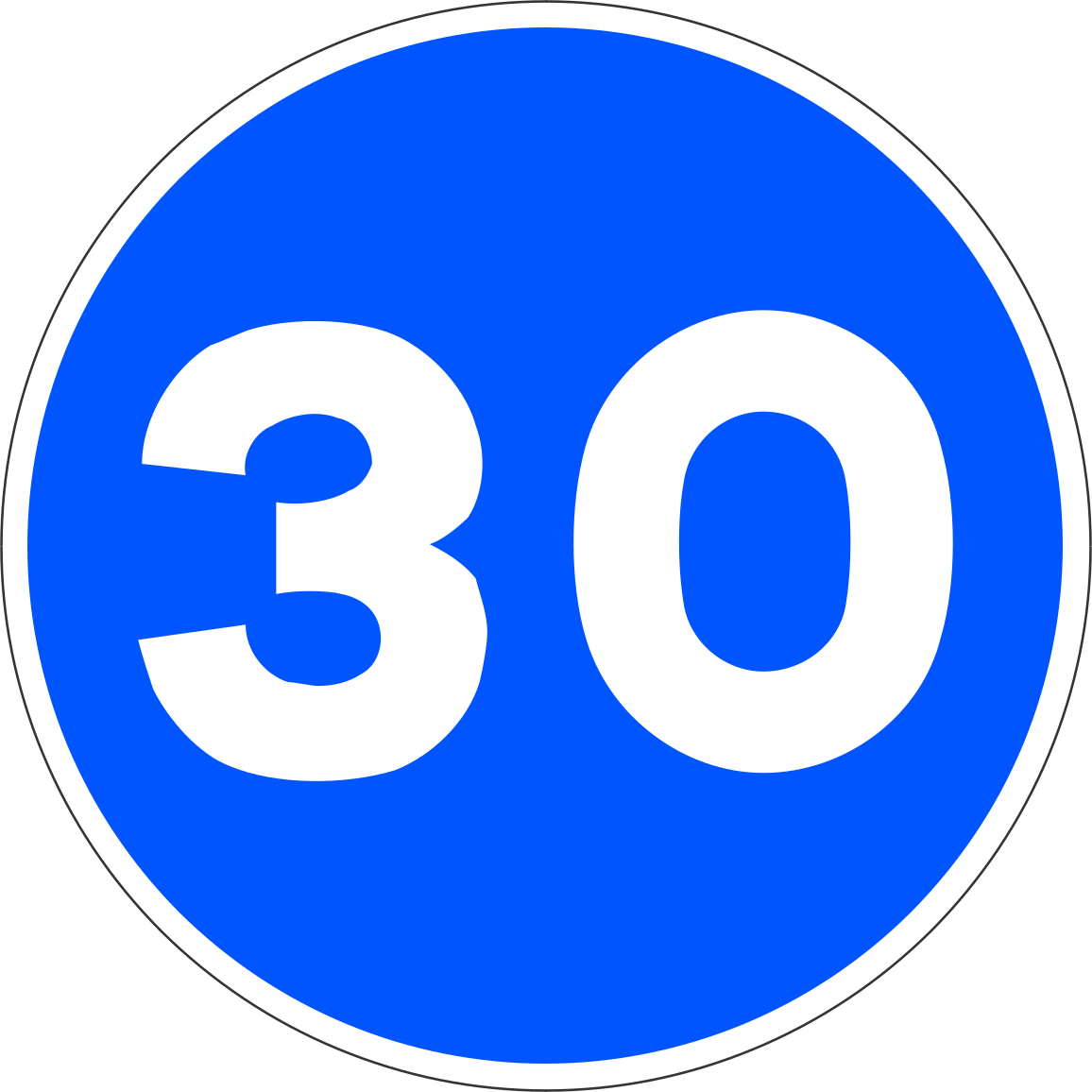
17.From this sign on, driving at 30 km/h or faster is...
prohibited.
recommended.
required.
Show answer
Answer: C. required.
This sign (R-411) sets a minimum speed. From this point, you must drive at 30 km/h or more. It is a legal obligation, not advice, and it lasts until another minimum speed sign or an end-of-minimum-speed sign.
18.On a divided highway (autovía), can you go over the speed limit in a car while passing?
No, it's prohibited.
Yes, by 20 km/h.
Yes on a freeway (autopista), but not on a divided highway.
Show answer
Answer: A. No, it's prohibited.
Spanish law never lets you exceed the speed limit on freeways (autopistas), divided highways, or in towns, not even to pass another vehicle. There's no 20 km/h allowance on either road type.
19.Can driving at high speed be dangerous?
Yes, but only if the road is in poor condition.
Yes, because it makes it harder to control your vehicle in a dangerous situation.
No, because modern vehicles are built to travel at high speed.
Show answer
Answer: B. Yes, because it makes it harder to control your vehicle in a dangerous situation.
High speed makes your vehicle harder to control in a dangerous situation. Over time, it can also lower your concentration and slow your reactions. That's true on good roads too, and a modern car doesn't change it, so always drive at the right speed for the road.
20.On a road that runs through a town (travesía) with no specific speed limit posted, what is the top speed allowed when passing?
50 km/h.
70 km/h.
90 km/h.
Show answer
Answer: A. 50 km/h.
The general limit on through-town roads (travesías), as on urban roads, is 50 km/h. That limit applies when passing too, and you can't go over it. 70 and 90 km/h are above the legal limit.
21.Does your speed affect your ability to anticipate hazards?
It depends on the condition of the road.
Yes, the faster you go, the less you can anticipate.
No.
Show answer
Answer: B. Yes, the faster you go, the less you can anticipate.
Speed has a strong effect on anticipation, whatever the road conditions. The faster you drive, the less able you are to spot and react to possible dangers in time. So it doesn't depend only on the road, and it's wrong to say speed has no effect.
22.As your speed increases...
driving gets less dangerous.
your vehicle gets harder to control.
your vehicle gets easier to control.
Show answer
Answer: B. your vehicle gets harder to control.
The faster you go, the less control you have over your vehicle. That makes driving more dangerous, not less. An excessive or inappropriate speed can keep you from handling problem situations.
23.What is the speed limit for a passenger car on a divided highway (autovía)?
100 km/h, and up to 120 km/h when passing.
120 km/h.
120 km/h, and 20 km/h more when passing.
Show answer
Answer: B. 120 km/h.
For cars and motorcycles on freeways (autopistas) and divided highways, the maximum is 120 km/h and the minimum is 60 km/h. You can't exceed 120 km/h to pass, and no extra 20 km/h is allowed. Since March 2022, that extra allowance doesn't exist on any road.
24.In a passenger car, can you go over the speed limit while passing? (rules since March 2022)
Yes, by 20 km/h, but only on conventional roads (carreteras convencionales).
No, it's prohibited.
Yes, on any road.
Show answer
Answer: B. No, it's prohibited.
Since March 2022, you can't exceed the speed limit to pass on any road. Before that, cars and motorcycles could go 20 km/h over the limit on conventional roads, but that rule was removed. It was never allowed on freeways, divided highways, or in towns.