Traffic Signs & Signals: DGT theory test questions in English
Chapter 8 of 17 · 20 questions
Spanish signs, road markings, traffic lights and agents' signals, and the order of priority between them. Questions show the real sign, so learn the shapes and colors, not just the words.
Practice it properlyAnswer these one at a time and track the chapters you keep missing, or sit a timed 30-question mock exam.
1.At a traffic checkpoint, can officers make you take a drug test?
Yes.
No, this test can only be done at a medical center.
No, only if you are involved in a crash.
Show answer
Answer: A. Yes.
Officers can require a drug test at a checkpoint. It is not limited to drivers involved in a crash, and it does not have to be done at a medical center. Drivers who break traffic rules can also be tested.
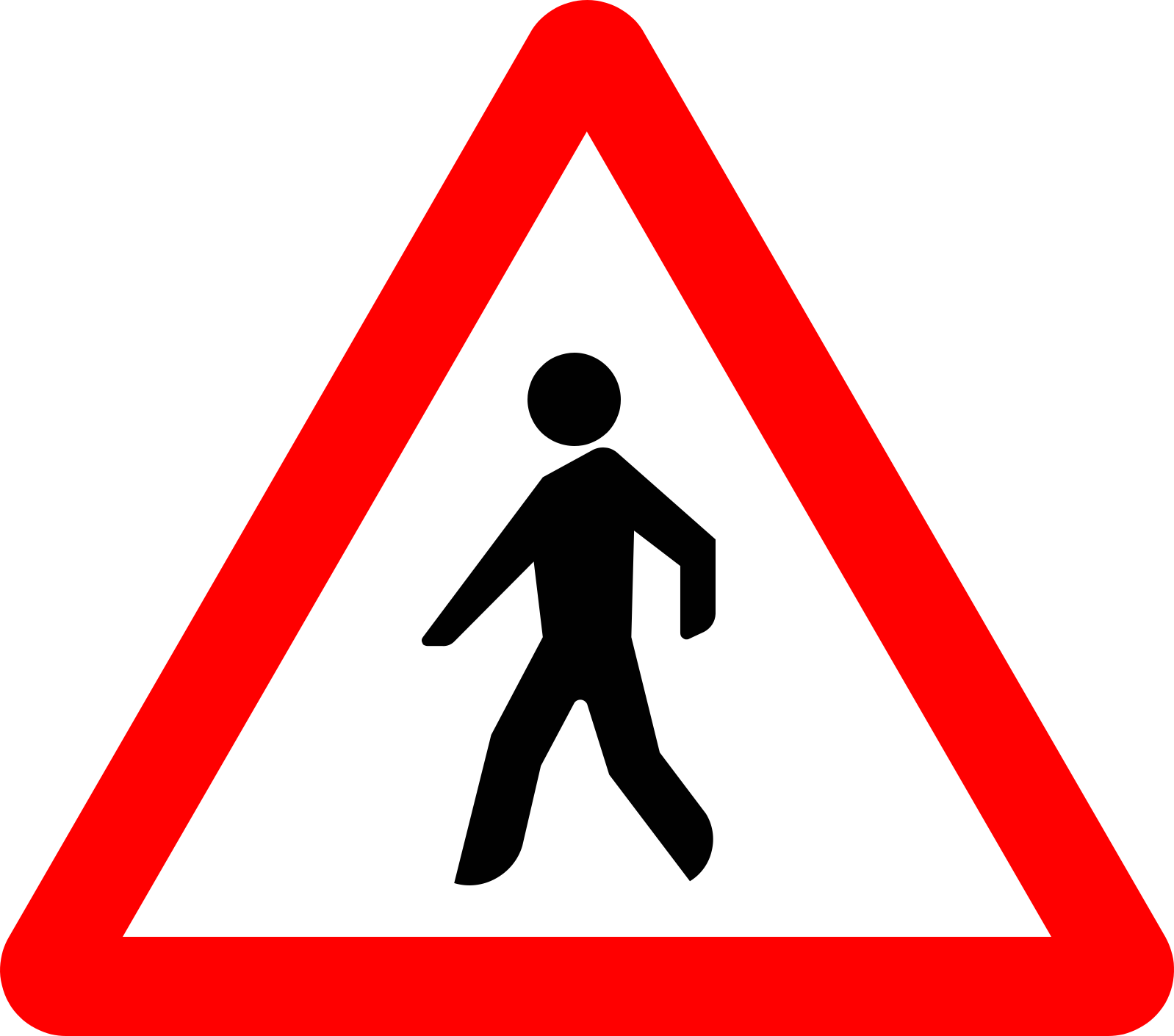
2.This sign warns you of...
a nearby place where children gather, such as a school or playground.
a ban on pedestrians using the roadway.
a nearby place where pedestrians are common.
Show answer
Answer: C. a nearby place where pedestrians are common.
This warning sign (P-20a) tells you that you are approaching an area with frequent pedestrians, often near a crossing. Slow down and be ready to stop. Children near schools or playgrounds have their own sign (P-21). A ban on pedestrians would be a prohibition sign, not a warning sign.
3.What does a dashed lengthwise line with the dashes very close together mean?
A dangerous section of road.
The start of a dashed line.
A special lane.
Show answer
Answer: A. A dangerous section of road.
A white dashed line with closely spaced dashes warns that a solid line is coming up, or that you are nearing a section with special risk. It does not mark the start of a normal dashed line or a special lane.
4.You are approaching a traffic officer from the front, and the officer is moving an arm up and down. What should you do?
Slow down.
Stop.
Keep going at the same speed.
Show answer
Answer: A. Slow down.
An officer moving an arm up and down is telling traffic approaching from that side to slow down. It is not a signal to stop, and it does not mean you can carry on without reducing speed.
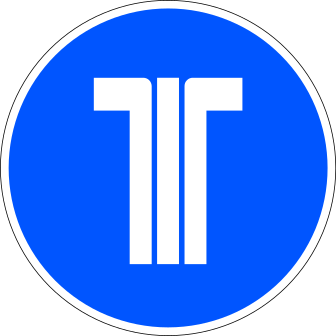
5.This sign means that...
you must pay the toll with an electronic (dynamic) toll system.
you can pay the toll only with a bank card.
you can pay the toll electronically or in cash.
Show answer
Answer: A. you must pay the toll with an electronic (dynamic) toll system.
This sign (R-418) marks a lane or section where paying the toll electronically is mandatory. Your vehicle must carry the device that pays the toll automatically. Cash and card payment are not accepted in that lane.
6.Except in special cases, all road users must obey traffic signs...
only when they don't contradict the traffic rules.
even when the signs are not on the road they are using.
even when the signs seem to contradict the traffic rules.
Show answer
Answer: C. even when the signs seem to contradict the traffic rules.
You must always obey traffic signs, even when they seem to contradict the general traffic rules. If a sign and a general rule say different things, follow the sign. Signs meant for other roads do not apply to you.
7.Traffic signs are used to...
confirm exceptions to the rules.
warn, inform, order or regulate the behavior of road users.
add to the rules.
Show answer
Answer: B. warn, inform, order or regulate the behavior of road users.
Traffic signs warn and inform road users in advance about road conditions and traffic situations. They also order or regulate how road users behave. Their purpose is not limited to confirming exceptions or supplementing the rules.
8.A solid white line is painted across your lane (a stop line). Can you cross it without stopping first?
Yes, when stopping is not required.
Yes, when there are pedestrians.
Never.
Show answer
Answer: A. Yes, when stopping is not required.
A solid line across the lane marks where you must stop when a stop sign, a crosswalk, a traffic light, an officer or a railroad crossing requires it. If none of these requires you to stop, you may cross the line without stopping. Pedestrians present are a reason to stop, not to keep going.
9.You reach an intersection with both a traffic light and a Stop sign. The light turns green. What should you do?
Obey the traffic light, which takes priority over the Stop sign.
Obey the Stop sign.
Obey the traffic light, but you must yield.
Show answer
Answer: A. Obey the traffic light, which takes priority over the Stop sign.
Traffic lights take priority over all vertical signs. With a green light, you go ahead with right of way, so you don't need to stop or yield. You obey the Stop sign only if the light is off or flashing yellow.
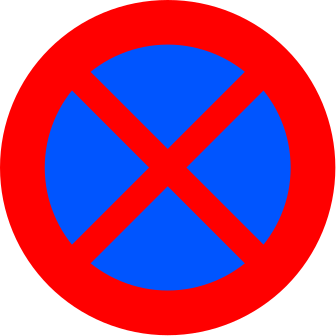
10.This sign prohibits...
Both stopping and parking.
Stopping, though parking is allowed.
Parking on even-numbered days.
Show answer
Answer: A. Both stopping and parking.
This sign (R-307) bans both stopping and parking. Unless another sign says otherwise, the ban starts at the sign and runs to the next intersection. It does not allow parking, and it has nothing to do with even or odd days.
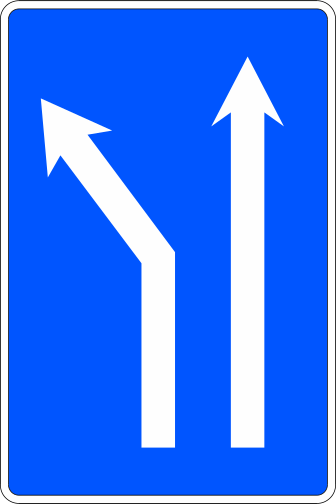
11.What does this sign mean?
You must turn left.
The road splits ahead, with the left lane branching off.
The road splits to the left, only for faster vehicles.
Show answer
Answer: B. The road splits ahead, with the left lane branching off.
This sign (S-60a) warns that a two-lane road splits ahead and the left lane branches off. It applies to all road users. It does not order a left turn, and the left branch is not reserved for faster vehicles.
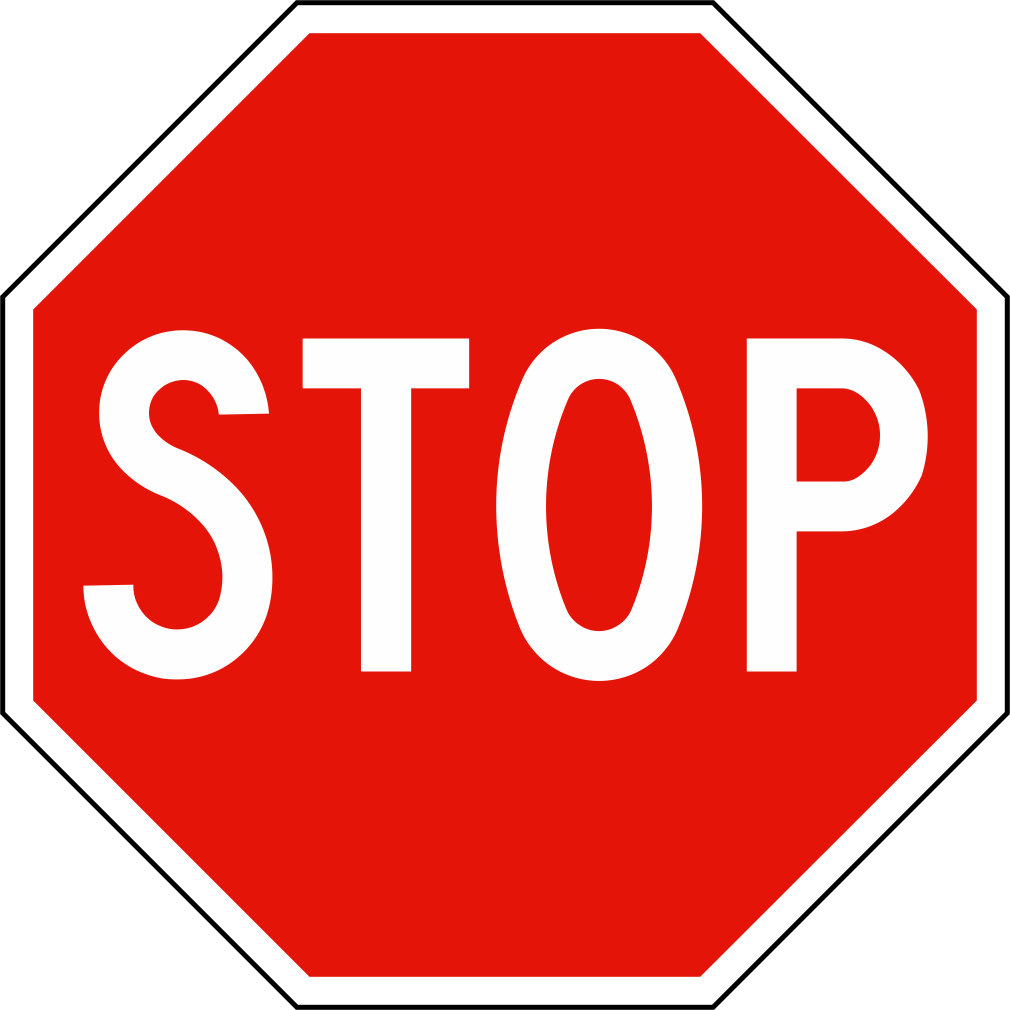
12.Does this sign always require you to stop?
No, only when visibility at the intersection is poor.
Yes, unless a traffic light tells you otherwise.
No, only when vehicles are coming on the cross road.
Show answer
Answer: B. Yes, unless a traffic light tells you otherwise.
This STOP sign (R-2) requires you to stop every time, at the stop line or, if there is none, just before the intersection, and then yield to traffic on the road you are entering. Visibility and the presence of other vehicles do not matter. The only exception is a traffic light, because lights rank above signs when they conflict.
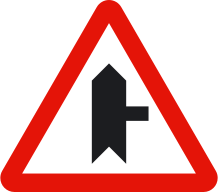
13.This sign means that...
you have priority at every intersection on this road.
you have priority at the next intersection.
at the next intersection, vehicles on the cross road have priority.
Show answer
Answer: B. you have priority at the next intersection.
This sign (P-1a) warns of an intersection where you have priority over vehicles on the cross road, whether they come from your left or your right. It applies only to the next intersection, not to the whole road, and it does not give priority to the cross traffic.
14.At an intersection, there is a stop sign on a post and a yield marking painted on the road. Which one do you obey?
The yield marking on the road.
The stop sign on the post.
Neither. The general right-of-way rule applies.
Show answer
Answer: B. The stop sign on the post.
When signals conflict, the order of priority is: traffic officers, then temporary signs such as barriers, then traffic lights, then vertical signs, and last road markings. A vertical sign outranks a road marking, so you obey the stop sign. The general right-of-way rule only applies when there are no signs at all.
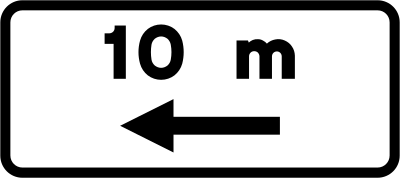
15.This panel, placed under a prohibition sign, shows...
how far the prohibition applies on both sides of the road.
how far the prohibition applies in the direction of the arrow.
the distance to where the prohibition begins.
Show answer
Answer: B. how far the prohibition applies in the direction of the arrow.
This panel (S-821, or S-820 when the arrow points left) tells you the distance over which the prohibition applies, in the direction of the arrow, here to the right. It does not cover both sides of the road, and it does not show the distance to the start of the prohibition.
16.When you see this sign, you must turn on at least your...
high beams.
parking lights.
low beams.
Show answer
Answer: C. low beams.
This sign (R-413) makes it mandatory to use at least your low beams on this road. Parking lights alone are not enough. High beams are not required and could dazzle other drivers.
17.This sign shows the location of...
A pull-out inside a tunnel.
A scenic viewpoint.
A place where you can make a U-turn.
Show answer
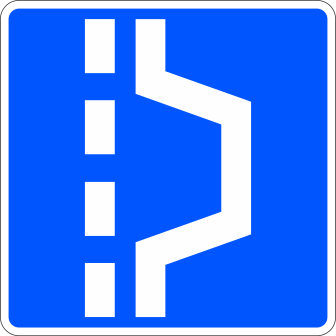
Answer: A. A pull-out inside a tunnel.
This sign (S-34) marks a pull-out inside a tunnel where you can move your vehicle out of the way and leave the lane clear for other traffic. If it also shows the letters SOS, the pull-out has an emergency phone. It does not mark a viewpoint or a U-turn spot.
18.What does this sign mean?
Only for trucks and vans over 3,500 kg MAM.
Required for all trucks and vans, whatever their MAM.
No trucks over 3,500 kg MAM.
Show answer
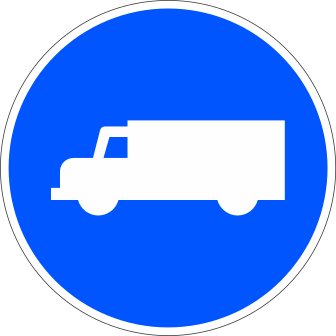
Answer: B. Required for all trucks and vans, whatever their MAM.
This sign (R-406) requires all trucks and vans, whatever their weight, to use the roadway it marks. Only if the sign shows a weight figure does the rule apply just to vehicles whose maximum authorized mass (MAM) is above that figure. It is a mandatory sign, not a ban.
19.A traffic officer on a motorcycle is displaying a red flag. What does this mean?
You must stop on the right.
There is danger ahead, so drive carefully.
The road is temporarily closed to traffic after the motorcycle passes.
Show answer
Answer: C. The road is temporarily closed to traffic after the motorcycle passes.
A red flag on a traffic officer's priority vehicle means the road is temporarily closed to traffic from that vehicle onward. Only the vehicles it is escorting may continue. It is not a stop-on-the-right order or a simple hazard warning.
20.What does this sign mean?
You are approaching a two-way road.
The right lane ends ahead on a two-way road.
You are approaching an intersection where you must yield.
Show answer
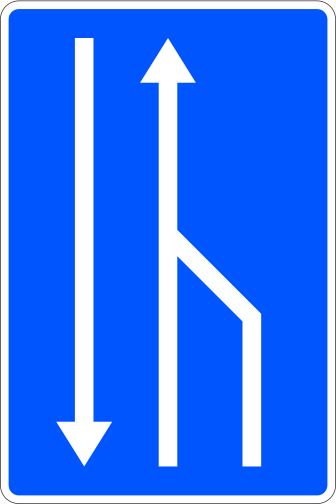
Answer: B. The right lane ends ahead on a two-way road.
This sign (S-52a) gives advance warning on a two-way road that the right lane is ending, and shows the lane change you need to make. It does not simply announce a two-way road, and it says nothing about right of way at an intersection.